

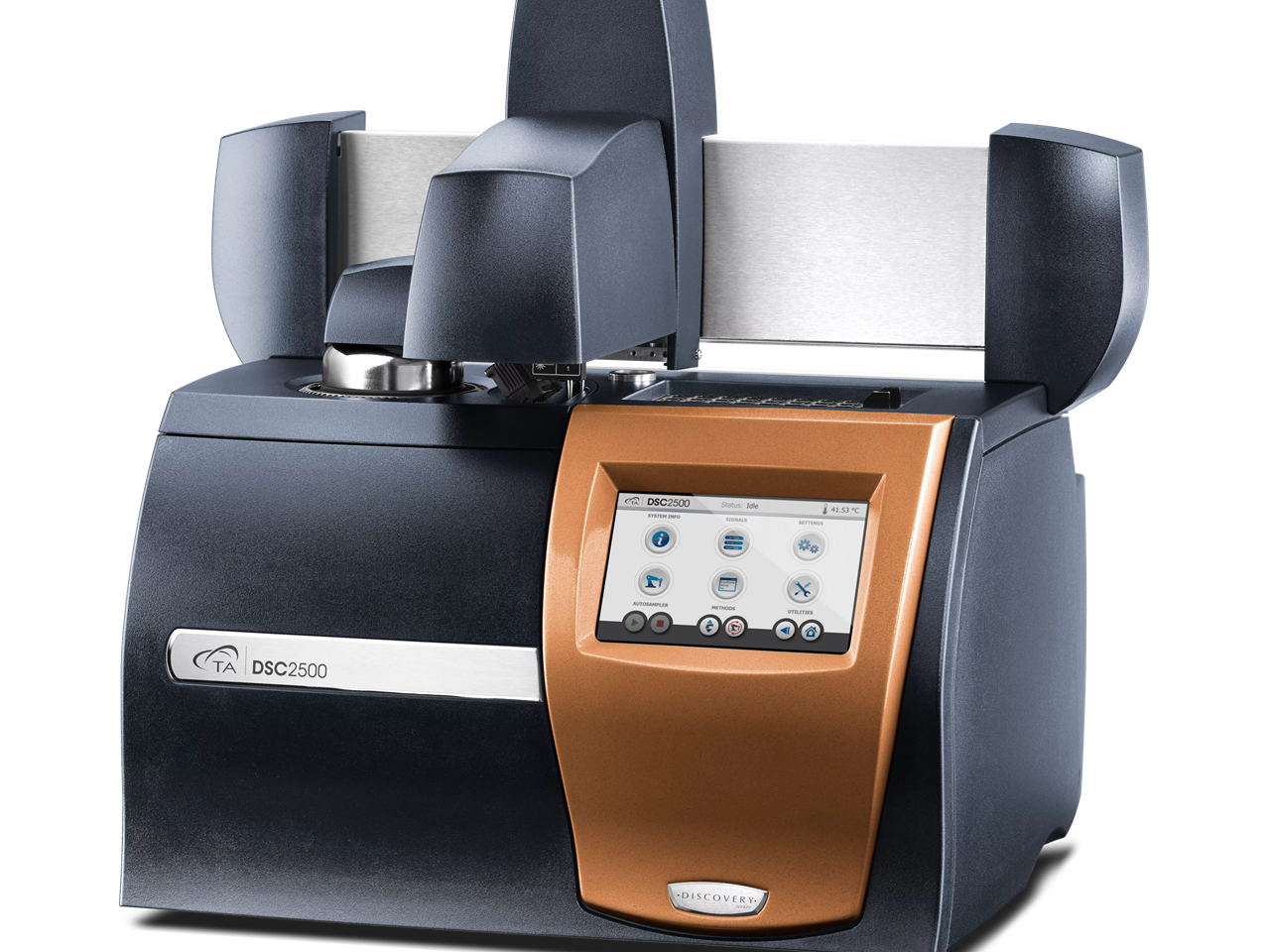
Differential Scanning Calorimetry (DSC)
Differential Scanning Calorimetery (DSC) measures temperatures and heat flows associated with thermal transitions in a material. Common usage includes investigation, selection, comparison, and end-use performance evaluation of materials in research, quality control and production applications.
Properties measured include glass transitions, “cold” crystallization, phase changes, melting, crystallization, product stability, cure / cure kinetics, and oxidative stability.
TA Instruments DSC 2500
- autosampler with up to 54 samples for high volume of material testing, allowing for 24/7 operation.
- Test temperatures: -120°C - 725 °C
Relevant standards:
- D3418 – Standard Test Method for Transition Temperatures and Enthalpies of Fusion and Crystallization of Polymers by DSC
- D3895 – Standard Test Method for Oxidative-Induction Time of Polyolefins by DSC
- D4419 – Standard Test Method for Measurement of Transition Temperatures of Petroleum Waxes by DSC
- D4591 – Standard Test Method for Determining Temperatures and Heats of Transitions of Fluoropolymers by DSC.
- D5028 – Standard Test Method for Curing Properties of Pultrusion Resins by Thermal Analysis
- E793 – Standard Test Method for Enthalpies of Fusion and Crystallization by DSC
- E794 – Standard Test Method for Melting and Crystallization Temperatures By Thermal Analysis
- E1269 – Standard Test Method for Determining Specific Heat Capacity by DSC
- E1356 – Standard Test Method for Assignment of the Glass Transition Temperatures by DSC
- E1782 – Standard Test Method for Determining Vapor Pressure by Thermal Analysis
- E2160 – Standard Test Method for Heat of Reaction of Thermally Reactive Materials by DSC
- E2716 – Standard Test Method for Determining Specific Heat Capacity by Sinusoidal Modulated Temperature DSC